Thursday, December 15, 2011

Mitch Epstien, American Power 2003-2009


I was lucky enough to see the series American Power last summer while visiting the Tate Modern as apart of  the museum's New Documentary Forms series. It's funny,  looking at Epstein's prints, it's hard to not to think I'm look at a painting. The compositions contain a poignant ethereal quality, as if the environment itself was created from the imagination of the artist.

His images are crisp and still even when capturing motion. He utilization light and the elements to assist the character of his prints. Each photograph feels self contained, as if nothing really exists outside of the 70 x 92 inch print.

Guy Tillim

 
   I'm in love with the work of Guy Tillim. My initial interest developed after seeing a few of his images at the Tate Modern. He speaks with muted colors and and understated subject matter that ,given time, reveals a lingering visceral presence. After hearing him speak about his work, my appreciation grew exponentially. He carries a system of ethics that have developed over the course of twenty-plus years, spanning  from his early work during the Apartheid in South Africa.
   Photography inherently tells a story. Documentation is then a form of fiction. The ramifications of this, on those who work in this vein, is everything. Tillim displays a remarkable awareness of these concepts. His unique perspective and talent leads to amazing results. The portraits he creates, whether it be of a person or of a city, capture a sense honest beauty that, quite frankly, I fail to describe.

Roni Horn

From the series You Are the Weather


As with most photographers,  my interest in their concepts usually develops out of an initial appreciate for the aesthetic aspects of their work. With Roni Horn, those developed simultaneously. Her process is intriguing and the resulting prints stand as a test. Her images are made under soft even lighting that casts minimal shadows, just strong enough to set a sense of space. The colors explored in much of her work subtly compliment each other. There's a remarkably refined asymmetrical balance in her compositions. Interestingly enough, I feel as though these elements take a back seat to what is being represented. Her aesthetic choices don't really draw attention to themselves but come together to create a harmonious whole. Essentially, in doing this, she creates 'place'.
This ties into the conceptual side of her work. In her series "You are the Weather" Horn talks about wanting to create a sense of place, similar to that of a landscape, in a portrait.

There is something congruous between all of Horn's work that seems to always suggest place. In these portraits, the space around the woman, the water and the air, become just as immediate as the woman's face. Her stoic expression suggesting a kinship with the rocks and earth that form the mountains.

Frank in the Pond


Frank, is a character created by artist Jim Woodring that exists in the medium of Graphic Novels. I was exposed to Woodring's work while visiting the Boise Art Museum. After reading a collection of work about Frank, I'm sold. The work is whimsical, it's charming, and at a times it's so dark and enigmatic that it escapes classification. At this stage, the only reaction that seems appropriate is to laugh but you feel kind of weird about. 

The idea of popular art being shown within an arena dedicated to fine art is one of the most interesting aspects of my visit.  I've recently been delving into the the arguments surrounding these two spheres presented by Greenberg and then rebutted by Alloway in reference to Pop Art.. The presentation of this work in an art gallery recalls ideas of Pop Art's appropriation of popular images. Of course this existed in entirely different contexts. The original work was not exactly being  appreciated on its own terms. Structuralist ideas of creating new meanings out of everyday symbols were being expressed. The work of Jim Woodring is being presented as it is: Art, with a capital A. I still feel that ideas of appropriation are at play. If the gallery space exists as representation of culture, then including outside art represents at least a statement. 

Graphic novels exist in the world of mass art, or least they have historically. Have they now been recognized finally as an element of high culture? Comparisons to film are hard to escape in this instance. There are films that act as and are understood as art. There are also films that are blatantly kistch. It seems as though the fine art community is beginning to recognize a growth in certain graphic novels that warrants a separation between graphic novels as art and graphic novels as kitsch.

ann Hamilton, follow | 2011

Ann Hamilton, follow | 2011

In this video installation  we see two screens with in our screen. (This is because we're viewing a documentation of the installation.In that sense our reading may be affected). These screens are placed at distances almost as if they were eyes themselves. Inside of each screen a hand, covered in a molding of brown paper, draws a circle. The motion of the hands move opposite each other. One clockwise the other counter. The camera moves in and out, and around,  to follow the action. This opposing movement accompanied by the moving camera, creates a sense of dislocation. As is this weren't enough, Hamilton employs the use of audio, which is the amplified scraping  of the pencil across the paper as it draws its continuous circle. Similar to screens seeming associate themselves with eyes, separate speaks (left and right) play stereo audio.
   This entire experience was uncomfortable. When studying this work, however, I tried to move past this first jarring experience as I've come to understand that many video artists hide their concept underneath my initial response of disgust.
   The first element I began to analyze was the hands. There was no attempt to hide the skin that could be seen at her wrists. The paper almost gave the allusion of old mummified skin. This definitely added to the level of discomfort I felt when watching the piece. However, the paper does make reference to her medium and I don't think that can be ignored when trying to piece this puzzle together.
   The second element I began to consider were the lines themselves. Hamilton herself has this to say about lines when referencing this and projects similar to it.

" a line contains all the attention present in its moment of making, the rhythms of breath and body, the weather of hesitations and the stutter of the hand orbiting in the body’s immediate periphery.  Folded, cut or accreted, the line’s incessant horizontality returns to itself and takes a circular form.  It is simple work; it requires the body to be slow. "((Hamilton)

Hamilton's fascination here seems to be focused on the process and the moment of creation in drawing. This is even boiled down to its most simplest component. 
With her use of audio and the presentation of the video, I feel as though Hamiton's success lies in her ability to make use feel as though that moment of the process is tangible thing. 
I can't say I enjoy this piece outside of an intellectual level. In giving the artist due credit, I'm going to assume this experience was not meant to be pleasurable. If I'm correct then she wants us to feel uncomfortable. Maybe she wants us to feel an anxiety associate with this stage of creation. Then again, maybe she wants us to remember our bodies. I react to this noise out of instinct. In this way, my experience was not only on an intellectual level but on a physical level. 

Robert Gober


      I find myself most interested in Gober and his sinks. There's an immediate reaction in the form of whimsy when first viewing these sinks. For some reason when I see them, I see a person and it's funny. This initial reaction only adds to how the effectiveness of Gober's message. When I found out these sinks were talking about the AIDs epidemic, I still saw the person in the sink but only because they were missing. And additionally I began to see two people instead of one:two people who were no longer at a sink in the morning. The sink is such a simple representation of home and all of the ideas of companionship that comes with that.
     I can't imaging how relevant this must have been during the height of the epidemic. I think it's effectiveness lies in the initial mystery that is created by its mere presence in a gallery and secondly by it's missing parts. Because of the latter, you're forced to contemplate the object.
     As objects they hold a sort of presence that I find appealing. I can also imagine initial comparisons to Duchamp's ready made during the armory show. I imaging this created quite a bit of intrigue in this reference and then even more intrigue when the concept behind it carried some much social weight.

What's not to love about Jeff Koons?

EVERYTHING.

Jeff Koons.  I hate him and I love him. But I only seem to love him at times when I don't believe in art. It has something to do with what he means to art.  His work and presence in the art world feels like art histories longest practical joke. Art is not sacred, it is a commodity. Art in fact is not even beautiful. What is beauty anyway? Is it a large dog made of flowers?


Nigel Scholfeild

Jeff Wall


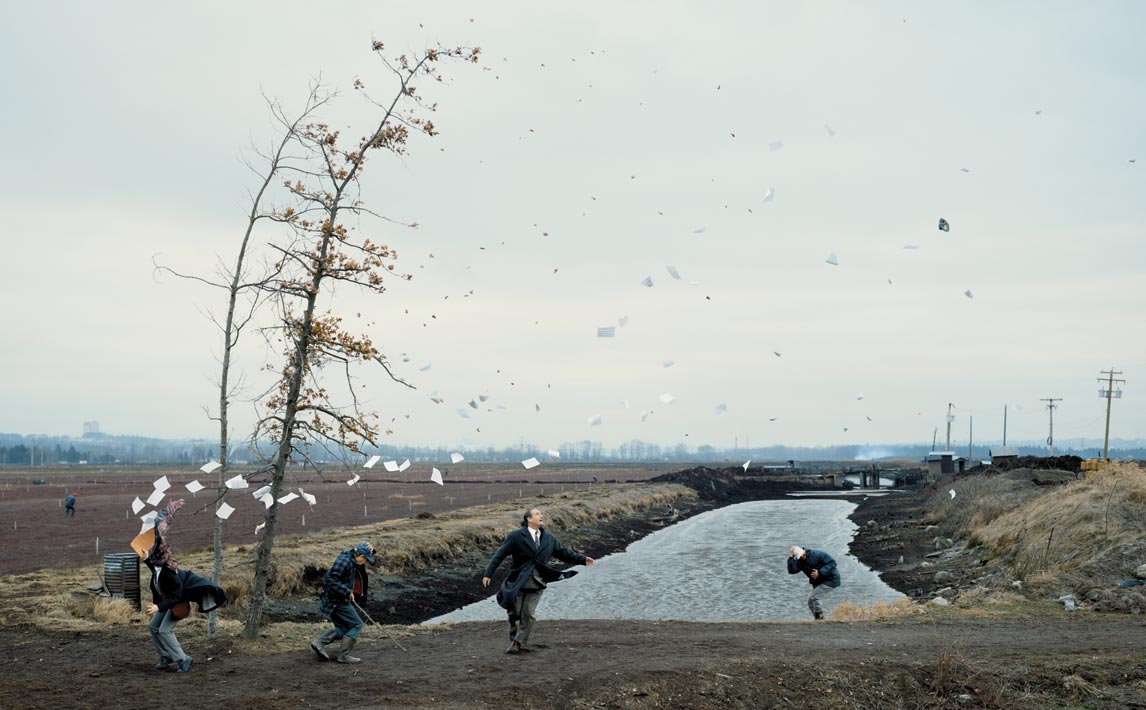
Jeff Wall's photographs are orchestrated gems. They exist in a world between painting, photography, and cinema. His work was introduced at a time when these elements had not explored as a means of art. His scenes are thoughtful compositions that carry emotions along with them.

Matthew Barney's Cremaster Cycle


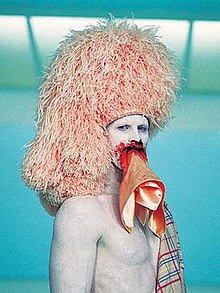
Matthew Barney's concepts take place inside of fantasy world with animorphs, high key complimentary and analogous color schemes, and Bjork. His work often involves the idea of animals, which may be alluding to the primal character of sex, of humanities true animalistic nature. However, what seems to be the main characters in his performances is a man. His themes reference ideas the male sexuality and virility. Essentially his work is about the physical exertion put forth in creating a piece of art work. In the third Cremaster Cycle the main character scales the inside of the New York Guggenheim museum. The word Cremaster reference a part of the male anatomy that lowers and raises the testicles. This, and several moments of his film in which ideas of the reproductive process seem to be depicted, cause me to believe that these fantasy worlds exist inside of this process of reproduction. 

Jan Fabre, Sanguis/Manti,2003


Jan Fabre is an artist working out of Belbium who is known for his work as a sculptor and as a draftsman. His work often includes the exoskeletons of beetles, iether in actuality or in representation. His culture Sanguis /Manti,  2003 is a suit of armor that shares its form with that of an insect. Fabre's long standing interest in beetles is rooted in their association death in northern renaissance vanitas paintings. . In an interview with Michael Amy  in Conversations on Sculpture, Fabre says, "Beetles have survived for millions of years. They possess information, they have the greatest memory. These creatures can be understood s the oldest computers,  the oldest memories. I load the empty spaces of my bodies with that memory."

In choosing this specific hybrid form, Fabre is placing humanity in a timeline. His idea of memory and the use of a suit of armor recalls a time that has past. He connects humanity with this single icon. In depicting this armor, he is referencing our mortality as a species. In using the beetle to represent this aspect of man, he adds a level of sadness manifested in how powerless we are to stop it. The stature of the figure, and the material it's made of suggests a certain level of composure and even distance that keeps this work from feeling too didactic in message.

Manufactured Landscapes. (The Film)


     The film Manufactured Landscapes explores photographer Edward Burtynsky's artistic documentation of Industrial China.  The sheer scale and unexpected beauty of these landscapes evokes a sense of the sublime. Burtynsky's images use mass repetition on an astounding level, as well as rich unexpected complimentary colors  to achieve this level of majestic beauty.
    The idea of the sublime is often conjured in representations of the grand scale of nature. In this film the emphasis is on the human element carving into the behemoth of the landscapes and industry taking the role nature once held on it's own. The film repeatedly emphasizes this theme throughout. Perhaps one of the most poignant examples occurs when the filmmakers follow Burtynksy to the construction of the Three Gorges Damn on the Yangtze river. A project that has taken over a decade to build and has flooded over 200 squares miles of land in order to bring electricity to the people of China. Burtyunsky's work often explores t destruction of nature in order to mine its resource. This often leads to high levels of pollution and an industry seemingly unaware of the growing environmental problems posed by these actions. This film explores this matter on a global level, as China's economy & hunt for resources ties in with the rest of the world's. It does not seek to indict humanity for what it does, the filmmakers very aware of their compliance in all that is happening. The issue is understood as complex. As an artist Burtynsky wants to create a discussion or at least an interest in a discussion.

Kiki Smith

Kiki Smith is an odd bird to say the least. When finding inspiration for her work, she relies on moments of inspiration and follows that intuition to it's end. She works in both two-dimensional work and in three-dimensional sculpture. Her work often carries primal qualities to it., often depicting woman being close to nature or a part of nature as scene in the doe birthing a woman. This connection to nature may represent an aspect of her perceived identity. Is Kiki Smith this human deer child, the woman stepping out of her wolf shell? 
Her work often carries with it a sense of poetry or even magic in its enigmatic representation. Her drawing and sculptural work are styled, either in the rendering of the figures or in their relative sizes. Kiki Smith is creating what is being fed to her through her muse. What she creates is filtered through whatever medium she chooses to use but the haunting almost comically dark works of art stir up memories of nightmares you wish you were odd enough to have. 


incomplete treatise on the intersections of language and art...just kidding. but seriously.

    Between experiencing art and writing critically about it, there is disconnect. For me this process can be either reductive or it can attempt to become the sensory experience it's trying to understand. The reductive approach compresses complex concepts categorically into words like schema, didactic, and Neapolitan ice cream. If this is not done correctly, it can lead to an uninteresting, simplified understanding. Sort of like the lazy character of that last sentence.
    In art that I enjoy I've always found something that escapes articulation. This mystery is what, for me, makes art interesting.When trying to articulate this part of an experience, I'm forced to use abstract language that feels as though it's reaching into the void itself. I'm starting to believe, in certain circumstances, this is what's most appropriate. Maybe abstract ideas cannot exist in any other language. And maybe-JUST MAYBE- this is how we begin to expand our schematized view of the world.
At night I sharpen my teeth on carrots.

Christo and Jean Claude


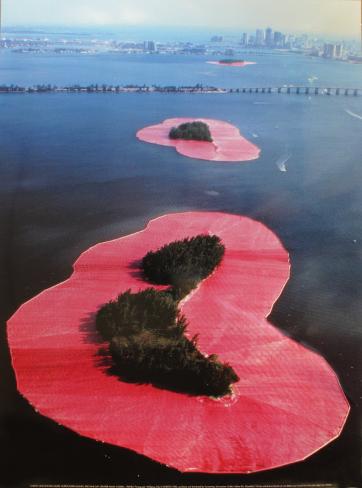
Christo and Jean Claude  work on a large scale, covering landscapes and monuments with brightly colored fabric with the intent of creating aesthetically jaw dropping works of art that also cause us to see the affected object in a different way.
            In the case of Christo and Jean Claude the pure scale of the work they design requires the hands of hundreds of people over hundreds of hours. In a sense this functions in similar fashion to architecture. While these mammoth fabrications are the end results of these artists collaboration with workers and volunteers, the two make their actual money from selling blue prints and sketches that they make during the planning stages of these works. However, these blueprints only contain value because of their association to the large temporary installation pieces. What is highlighted in Christo and Jean Claude's hand not being in the fabrication of their work, is the importance of the concept and our appreciation of beauty. While we appreciate the craft, we appreciate the concept over all. 

Naomi Fisher: Jungle Sweat, Roseate, 2011


           Naomi Fisher's Jungle Sweat, Roseate is an installation with a video component being held at the Vizcaya Museum and Gardens in Miami. According to an Art Forum interview with Fisher, the piece explores elements of the perceived exotic. Naomi's interest and understanding of this idea arouse from juxtaposing her childhood experiences of living in the jungle and her young adult life attending the Maryland Institute College of Art in Baltimore. ” For me, conventional Northeast architecture was like the other, whereas for nearly everyone else, it seemed, the tropics were the other. So I had very different ideas than most of my friends about what is wild, what is natural, and what is primitive.” The video asepct of this installation indirectly references her past when the main character of the film steps out of the jungle and into this modern world. Themes of conceive reality are explored as the piece plays out.According to Fisher's interview, this location always stood as a representation for th idea of exploring what is conceived as normal and what is conceived as exotic.
            I find this piece interesting as a fictional reprentation of the true experiences of Fisher's life. Not only does she include themes from her life that involve understanding notions of the other, the style of the piece essentially includes aesthetic elements that she came to appreciate during her time in Baltimore. According to Fisher, these include references to ”Gauguin, Nolde, and others who have depicted the female nude” and how these are “tied to an interest in the nostalgic depiction of nature versus female, and tropics versus conquest. But it also more simply connects with deep admiration for beauty and paintings that resonates with the life I’ve lived straddled between the tropics as my psychic reality and the American/European academy as my educated reality. “